Legion of Thunder
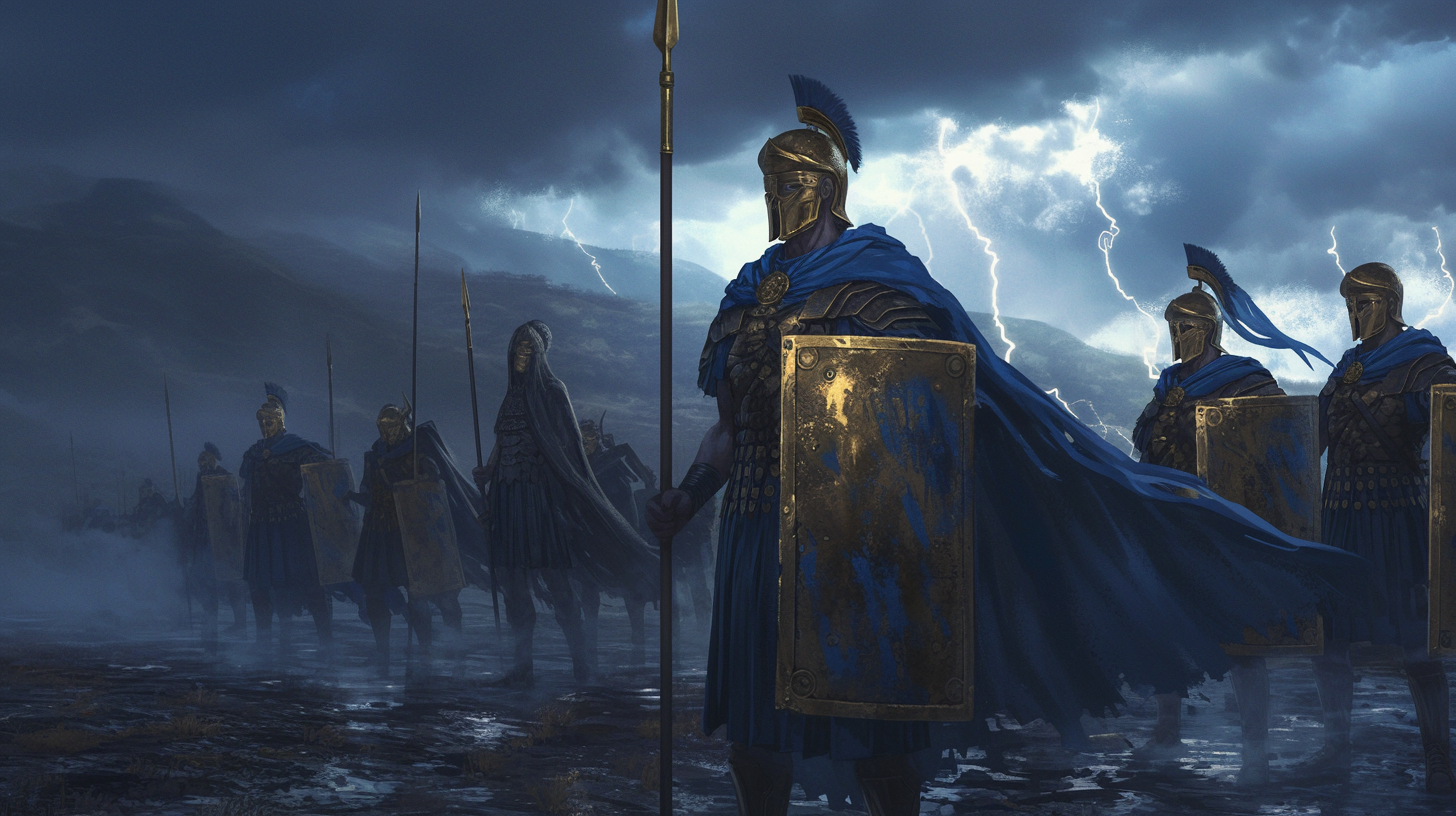
The Legion of Thunder was a military regime that gained control over the Cloudlands in 258 DHT. They usurped the former royal family of the Cloudlands and placed Hyperius, a powerful wizard-blacksmith, as the head of state. He assumed the title of imperator over the Cloudwellers, his reign becoming increasingly tyrannical. The Legion of Thunder's might mostly came from their leader's invention of thundersteel.
Structure #
The Legion of Thunder was ruled by the imperator, a single individual who was endowed with the power to issue commands to any subject under him. For the Legion of Thunder's lifespan, this title was held by Hyperius Tiamus Dominus. It was assumed that Hyperius' seat of power would be transitioned to his eldest daughter upon his death.
The imperator sat at the top of the chain of command, and directly below him were the six magistrates, who acted as governors over each of the six islands that make up the Cloudlands. Each magistrate possessed an army of soldiers separated into one hundred divisions, each one led by a capitis (who would lead the division), as well as around 10 centurions who led men on a squadron basis.
A personal army was also granted to the imperator, which was structurally identical to the armies of the magistrates. The only difference was that the imperator's army size was nearly tripled compared to a magistrate's, and it was led by the praetor. The praetor would serve a similar position to that of a magistrate, since the imperator could not be expected to do the job alone. The praetor was in line with the imperator, relaying any orders that the imperator sent to his soldiers. It is suspected this role was created to ease Hyperius' time, since he spent so much of his time in his forge creating thundersteel.
The praetor did not have the same level of executive authority that a magistrate would have over their own dominion--the praetor's job was exclusively to direct the imperator's armies in his absence.
The imperator also had an inner circle of individuals known as inquisitors. The inquisitors acted as personal servants to the imperator, and worked mostly to ensure the compliance of all other subjects under the imperator's rule. They were highly trained and fiercely loyal, comparable to the Songkram's famed Kwailok.
The Imperator #
Also known by foreigners as the "king," the imperator was an individual with complete executive authority over the Cloudlands. They were the only individual allowed to pass laws that take effect across all 6 islands. The Legion of Thunder's foundation lies with the faith that the imperator would lead them into an increasingly prosperous future.
The imperator held two main responsibilities. The first was in the military--the imperator primarily directed his own men through the praetor, but would also send tactical advice to the magistrates. The other role the imperator played was in dealings of the state. The imperator passed laws that were designed to govern either the whole of the Cloudlands, or just the capital city, Hyperius' Palace. Other civil duties included the passing of judgement on high criminals.
Hyperius, being the one and only imperator so far, was elected into this position in 258 DHT by his own followers during the Legion's inception. It was unclear as to what would transpire upon an imperator's death, as no laws were ever passed about the relevant proceedings. This was likely due to Hyperius' denial of having to face death eventually. The general consensus was that executive power would transfer to Sabina Tiama Domina, making her imperatrix. A mad scramble for power between the magistrates and the praetor was equally as likely depending on the political thermometer.
The Praetor #
The praetor was the military leader of the imperator's armies. Since the imperator's responsibilities lay with the whole of the Cloudlands, simultaneous management of both the military and people could become overwhelming. The praetor would dictate the movement of the imperator's men in the imperator's absence, or relay his orders when he gave them. The praetor's military position was equivalent to that of a magistrate, but without any of the executive authority.
The praetor was picked by the imperator from existing magistrates--usually the one that shows the most promise in terms of tactics and battle planning.
The Inquisitors #
![[Tempest Inquisition#^6f6f2f]]
The Magistrates #
A magistrate's role was to govern the people of their respective island. They possessed the authority to pass laws that only applied to their lands, although they still required the permission of the imperator in order for it to pass. The magistrates also had the ability to control their own armies freely--they do not have to follow the direct orders of the imperator. The imperator would have brought a magistrate into power in confidence that they would be obedient and do what was in the best interest of the imperator. If magistrates performed an action or issued a command that the imperator ruled as treason, they were either be executed by inquisitors or arrested and imprisoned. The sentence depended on the severity of the offense, of course.
Magistrates also acted as judges for crimes that transpired in their island domain.
Magistrates could choose to retire whenever they pleased. Upon the removal of a magistrate from power, whether due to insolence or retirement, a new magistrate was elected by the imperator to govern where the previous one did. Usually a successor was chosen in advance of the prior's removal or stepping down. In the case that a magistrate was suddenly gone without a successor in place, the imperator would take temporary personal responsibility of that island domain.
The Capites & Centurions #
A capitis' role was a military commander, leading a division of approximately 500 men. The capitis served as an intermediate between the magistrate or praetor and the centurions, who were squadron leaders. Centurions would then take the orders of the capites and command their squadrons, which were about 100 strong.
Both centurions and capites lacked any executive authority that the above ranks possessed. They were strictly military roles.
Centurions were picked from the most senior member of a squadron, and a capitis was picked from the most senior of centurions. The standard magisterial squadron (called a century), being comprised of 100 soldiers, was led by a single centurion--a magisterial division then possessed 10 centurions. While a magistrate's army would be around 50,000 men, the largest army, led by the imperator/praetor, was around 150,000 strong. This was approximately 300 divisions for a total of 3,000 centurions and 300 capites.
Each division or squadron often specialized in differing tactics. For instance, a magistrate may have 3 or 4 of their military divisions consist of cavalry, and within those divisions 1 or 2 squadrons may specialize in mounted, ranged combat.
Suggested reading: Thunder Legionary
Propaganda & Loyalty Programming #
Since the Legion usurped control over the Cloudlands, the threat of rebellion was a constant thorn in its side. While the Legion often combated insurgency and unrest through direct warfare, it also opted to use social engineering and other methods to lull the wider Cloudweller populace into a sense of prosperity and safety under the Legion's rule.
Opulence & Gold #
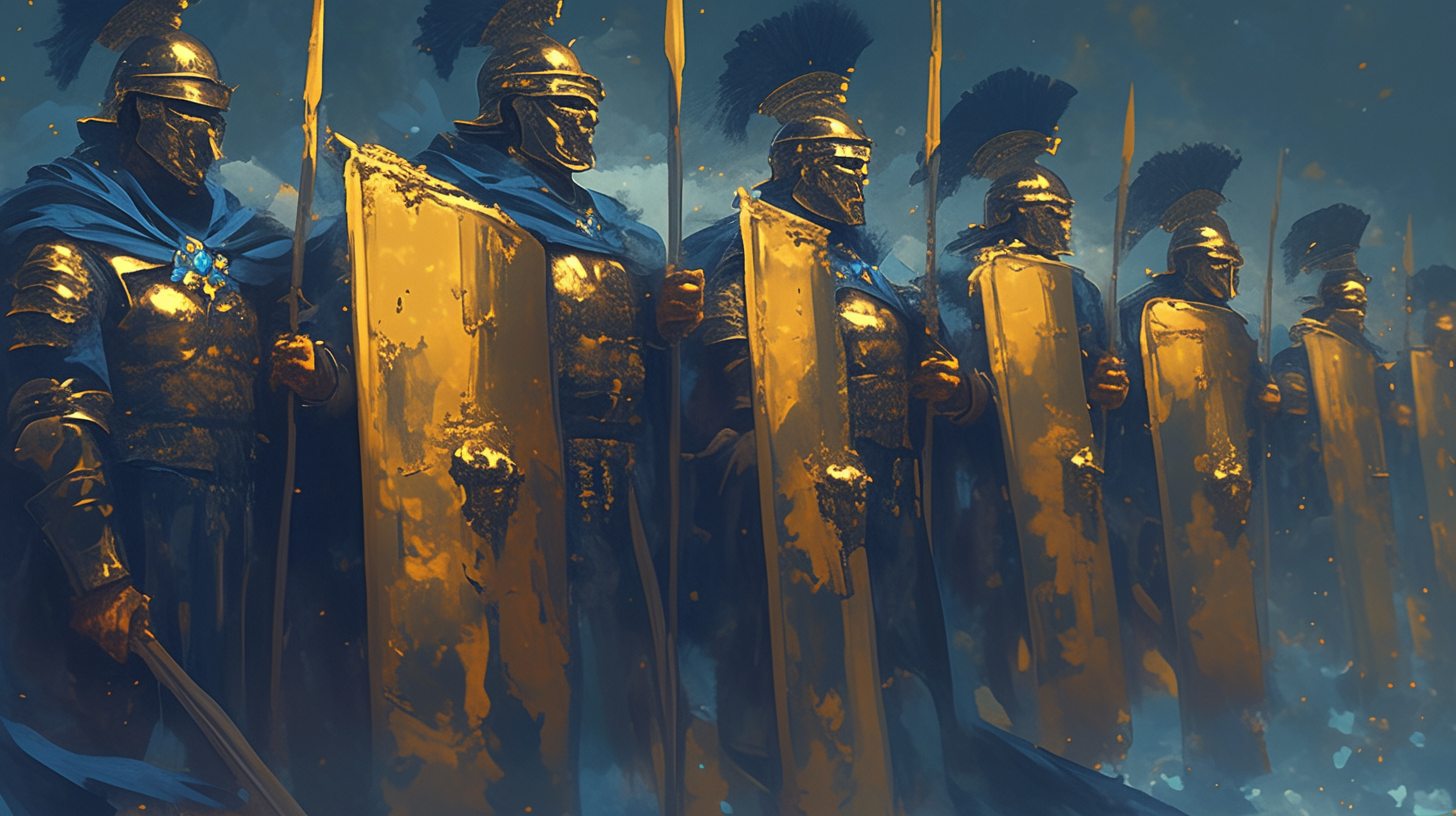
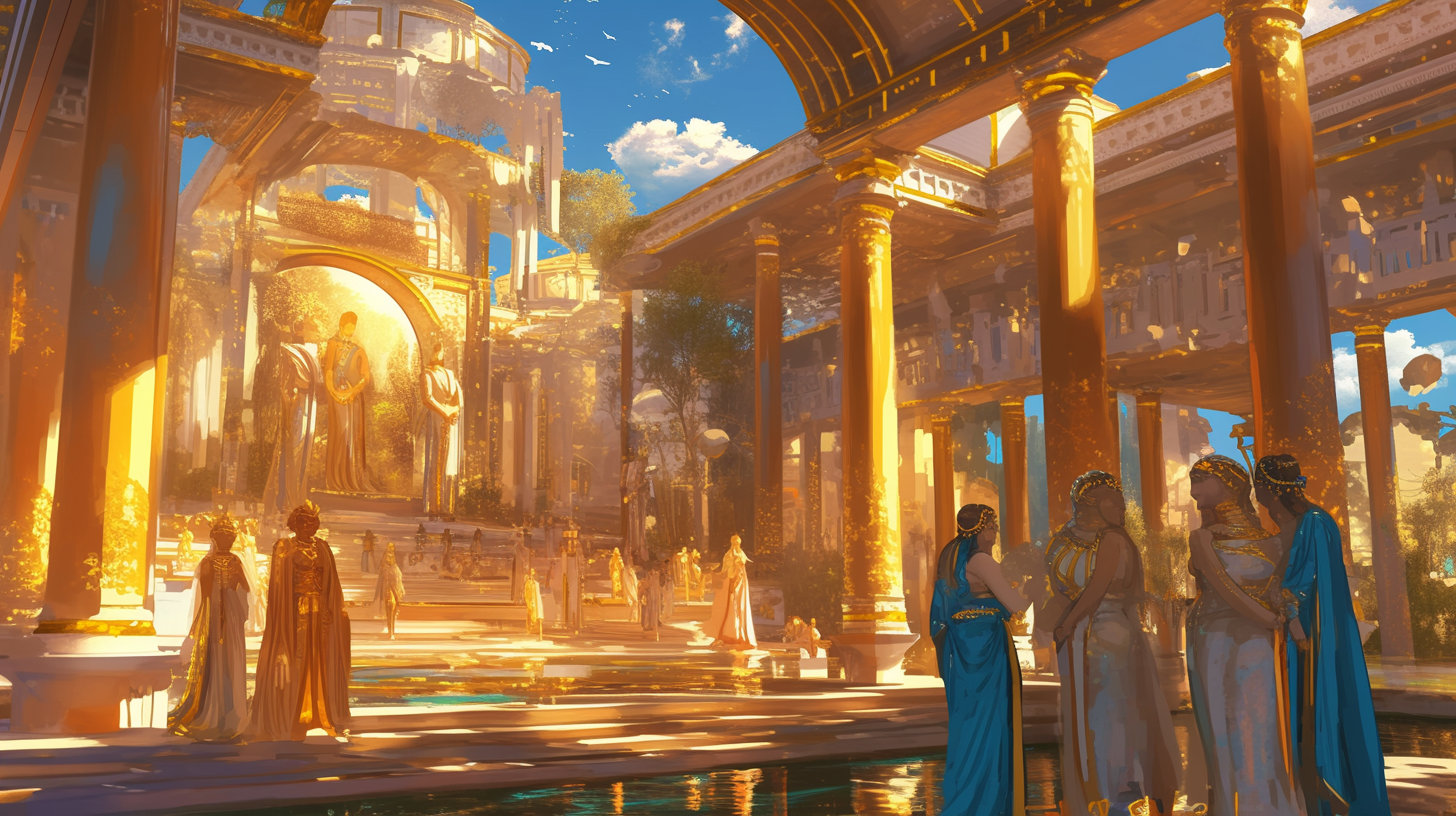 Imperator Hyperius was a lover of fine things and the colour of gold. This was most clearly displayed through his coating of Thundersteel in gold, transforming his armies into gleaming seas of sparkling aureate.
The capital city of the Cloudlands during the Legion's rule was Hyperius' Palace, a floating megastructure that was resplendent with gold.
While one could argue that the employment of gold in the Legions' decor was an aesthetic choice to please Hyperius, it did serve a practical purpose in giving the Legion an awe-inspiring, divine appearance. With ancient Legerian iconography (and more recent sightings of the Archangel Michael) depicting Angels clearly as gold-plated warriors, the golden armour and rich navy robes of the Legion of Thunder's warriors caused many to mentally associate the Legion with the forces of good. With this association in place, many citizens of the Cloudlands would easily cast aside any thoughts that doubted the Legion's own goodness.
The excessive gold and luxurious trimming found throughout even public streets where the commonfolk would go about and work assured them that they were living in a season of abundance and wealth brought on by the benevolence of their imperator.
The Daughters of Hyperius Program #
The strength of the Legion was in their soldiers. With so many thunder legionaries being conscripted from Cloudweller natives and other lands annexed by the Legion^1, it was extremely important that their loyalty lay with the Legion and not their people. To do this, the Legion put many measures in place to give special benefits to those who served the Legion in a military capacity. Many of these benefits were achieved after milestones, incentivizing legionaries to remain in the Legion's service for extended periods of time.
One of the central points of this service was the Daughters of Hyperius program, which saw the wives of thunder legionaries treated almost adjacent to royalty--as if they were Hyperius' own daughters.
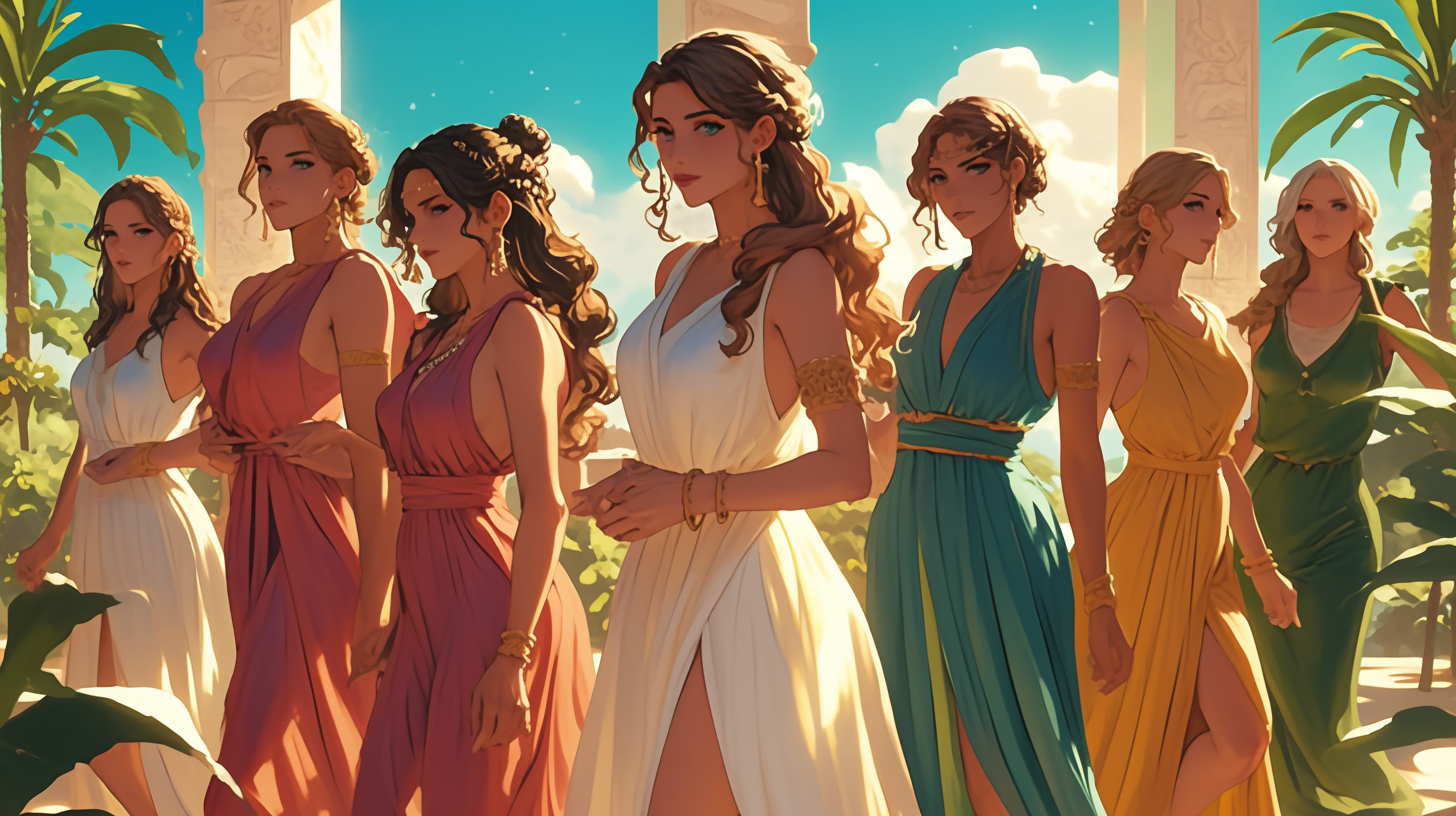
Women who were enrolled into the program were the wives of soldiers who had served for a minimum of 1 year. They were given access to beautiful gardens, pools, and spas and attended by loyal eunuchs. They were subject to an elaborate, state-of-the-art beauty routine that made them as alluring as possible for their weary husbands as they returned from duty. Tight security and surveillance also backed the program to ensure that family disrupting events--like adultery--never transpired. Legionaries could rest assured that their sweethearts were safe in the hands of the Legion.
However, underneath this luxurious, seemingly generous program was a most sinister purpose. The ultimate objective of the Daughters of Hyperius was to foster a dependance and feeling of debt to the Legion. Many legionaries would join the Legion from poverty, and served with the promise of being able to pull their loved ones into better circumstance. Leaving or turning on the Legion would cause a legionary's wife to be abruptly expelled, cut off from the fanciful life that they were spoiled with. Secretly, the wives of legionaries that were killed in action were executed. The Legion saw no reason to continue serving the wives of dead soldiers. This coldness was hidden to take away potential criticism against the Legion.
The program also extended to the immediate children of a legionary, providing education and bountiful, healthy meals for them.
The program grew to be so enormous in the latter years of the Legion that it was one of the primary sources of strain on the lower rungs of the Cloudweller society.
Parades #
Military parades were a constant show in the Legion's Cloudlands, serving to assure friends of the Legion while intimidating its enemies. Parades were nearly a weekly occurrence, sometimes transpiring 3 or 4 times a week in major cities (like Hyperius' Palace).